Tashan Technology, in Partnership with Turing Laureate Sutton, Launches "Robot Kindergarten" — Embodied Intelligence Shifts from Imitation-Driven Learning to Experience-Driven Autonomy
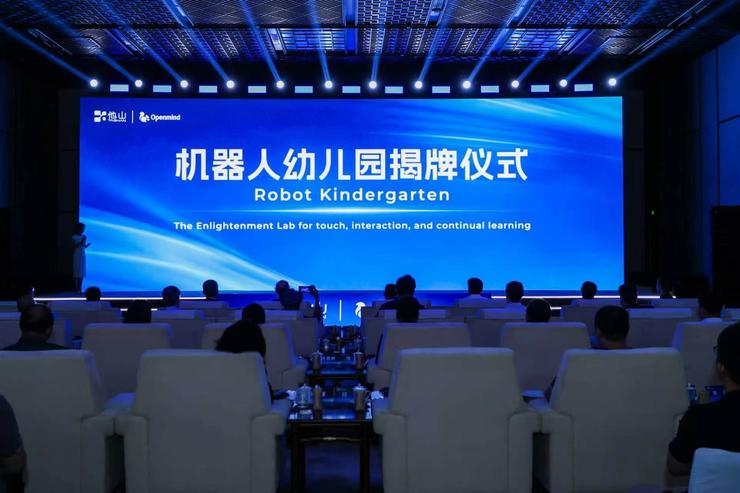
Leiphone reports that on June 29 Beijing Shougang Park hosted the "Touch Reality, Self-Evolve — Robot Kindergarten Launch Conference," co-organized by Tashan Technology and OpenMind Global Research, with the Beijing Institute for Embodied Intelligence serving as joint host. The "Robot Kindergarten" — co-developed by Tashan Technology and the team of Professor Richard Sutton, 2024 Turing Award laureate and Chief Scientist at Openmind Global Research — was formally unveiled. The initiative constitutes the first physical deployment of reinforcement learning theory within embodied intelligence, marking a definitive transition from passive, data-driven imitation to interactive, trial-and-error-based experiential learning.
I. A Kindergarten for Safe Curiosity and Controlled Experimentation
In his welcome address, Tashan Technology Chairman Sun Tengchen asserted that the global AI industry is converging on "tangible productivity" and requires a fundamentally new technological paradigm. The "Robot Kindergarten" positions tactile perception as its core breakthrough, designed to complete the full reinforcement learning loop — enabling robots to accumulate experience and evolve iteratively through autonomous interaction and sustained trial and error.
Professor Sutton — the iconic "Father of Reinforcement Learning" — then laid out the Robot Kindergarten's core philosophy. "For over 70 years," he observed, "AI has advanced through a persistent thread of exploration — learning via trial and error." Citing Alan Turing's 1950 paper, Sutton paraphrased: rather than engineering a program that mirrors adult cognition, one should build a program that mimics a child's mind, allowing it to mature and learn to think. Past attempts, he noted, were constrained by fragile hardware that left robots unable to acquire robust, real-world experience.
Hardware has since advanced substantially while costs have declined. Yet, according to Professor Sutton, behavior trained from human demonstrations remains "insufficiently robust." The solution, he contended, lies in interactive learning — robots must acquire competence through trial and error throughout their operational lifecycle, much as infants develop by accumulating experience over time. The Robot Kindergarten, he stressed, operationalizes this vision: machines learning online without human-provided examples. "This," he said, "is a dream of artificial intelligence."
Tashan Technology CEO Ma Yang, a co-initiator of the Robot Kindergarten, offered an industry rationale for its creation. Robots, he argued, require not static data but experience that is continuously generated and refined through interaction. Tactile sensation is the sole channel connecting intelligent agents — biological or mechanical — to the physical world; only through touch can objects be engaged and objectives altered. Since its 2017 founding, Tashan Technology has concentrated exclusively on this domain. To date, hundreds of thousands of its tactile fingertips are deployed across humanoid robots globally.
"Kindergarten" denotes the initial stage of autonomous discovery — when a child begins to shed protection and engage the physical world directly. Tashan Technology will accordingly provide four essential conditions: permission to err, a safe environment for exploration, sustained real-world interaction, and prompt, unambiguous feedback. Ma Yang concluded with an open invitation to all embodied intelligence professionals to serve as robotics educators: "We possess sufficient patience and humility, for we believe this is not merely the enlightenment era of embodied intelligence — it is the enlightenment era in which humanity and embodied intelligence together welcome the coexistence of carbon-based and silicon-based life."
II. An Open Ecosystem with a Robust Foundation
Following the keynotes, guests activated the launch mechanism amid a synchronized countdown, formally inaugurating the "Robot Kindergarten." The moment signals embodied intelligence's transition from passive imitation to proactive discovery.
The inauguration, however, was only the opening act. Translating the platform into a genuine driver of industrial evolution requires broader participation. The "Robot Kindergarten First Joint Ecological Partnership" was subsequently launched, with representatives from Acceleration Evolution, CloudMinds Robotics, InTime Robot, Tashan Technology, Openmind Global Research, Beijing Weishi Institute for Embodied Intelligence, Beijing Humanoid Robot Innovation Center, JAKA Robotics, and Zidong Taichu taking the stage. Tashan Technology has assembled capabilities spanning core components, full-machine integration, algorithmic frameworks, and application scenarios — forging an open, safe ecosystem designed to encourage experimentation and autonomous evolution.
On the technical front, Tashan Technology R&D Vice President Hou Guangdong and Openmind Researcher Dr. Kris De Asis delivered substantive commentary. Hou outlined a joint exploration with Professor Sutton into "sustained, long-horizon learning on real systems." In the robotic "infancy" stage, he asserted, "the most critical first sense is likely touch," positioning it as the "foundation for active exploration." Tashan Technology intends to leverage tactile sensing to define robotic "pain" mechanisms, thereby driving intrinsic exploratory motivation.
Dr. Kris De Asis then introduced the paradigm of "designing for learning." "Whenever I propose learning directly on the robot itself," he related, "I encounter a recurring objection: robots will wear out and fail." In his view, this is both a challenge and the defining merit of real-time learning — the robot internalizes degradation as an environmental reality and adapts accordingly. The machine learns to execute tasks despite — and indeed through — such wear.
III. A Dialogue on Growth and Value
During a panel entitled "In the Era of Robotic Enlightenment: How Embodied Intelligence Achieves 'Autonomous Evolution'," moderator Zhang Weimin — Deputy Director of the Embodied Intelligence and Robotics Department at the China Academy of Information and Communications Technology's AI Research Institute — opened by asserting that Professor Sutton's proposed transition from a "data era" to an "experience era" fundamentally redefines "how intelligence grows."
Professor Sutton traced the collaboration's genesis: "We selected Tashan for their tactile specialization and our mutual conviction in experiential learning." He credited Tashan Technology's deep commitment to tactile perception — above all, its alignment with trial-and-error learning principles and rapid execution — as the decisive factors behind the joint venture.
Tashan Technology Chairman Sun Tengchen detailed the convergence of tactile sensing and reinforcement learning: "Touch supplies a safe trial-and-error boundary and temporal precision for reinforcement learning." Capacitive proximity sensing enables pre-collision detection and avoidance, materially reducing experimentation costs. Dynamic tactile technology pushes temporal resolution to the microsecond scale; combined with neuromorphic chips that intrinsically support "spike-timing-difference" algorithms, this establishes a robust hardware platform for autonomous robotic learning.
Beijing Humanoid Robot Innovation Center CEO Xiong Youjun addressed the matter from an ecosystem standpoint: "An open ecosystem outweighs isolated breakthroughs. Layered collaboration across industry, academia, research, and deployment is essential." He urged the embodied intelligence sector to mobilize three partner categories — academic R&D, core component specialists like Tashan Technology, and application-domain practitioners — to accelerate intelligent evolution and commercial deployment via open, shared, multi-tiered coordination.
SoftBank China Managing Partner Song Anlan offered an investor's assessment: "Past eras saw educational and technical training. The AI era calls for experiential training — for robots." The Robot Kindergarten, he projected — as a globally unprecedented learning paradigm — would produce material economic returns within several years.
A second panel, "From Kindergarten to the Real World: How Robots 'Earn Their Keep,'" was introduced by CITIC Securities Investment's Huang Yaoting with the figure "1 million units" — a threshold he promptly reframed: "I care less about shipping a million units than whether the robot can actually perform useful work." The emphasis, he argued, must revert to the sustained evolution of learning methodologies and capabilities.
Openmind Global Research Senior Researcher Dr. Kris De Asis confronted the data-silo challenge directly: "Open-source initiatives must extend beyond algorithms and datasets to encompass electromechanical design." Hardware and model open-sourcing, he urged, should proceed in parallel to accelerate the pace of shared innovation.
Shougang Fund General Manager Zhang Meng pinpointed the critical deployment bottleneck: robotics firms must "begin by solving small problems to comprehend the entire industrial workflow." Genuine immersion in real-world scenarios and a willingness to undertake painstaking groundwork remain the only path from laboratory proofs to commercial orders.
JAKA Robotics Vice President Xu Xiong compressed tens of thousands of deployments into a single maxim: "Safety and interactivity are what liberate robots from physical enclosures." Crossing the reliability threshold, he implied, is the prerequisite for human-robot collaboration in the open world.
InTime Robot Co-founder and CTO Chen Xi envisioned a future propelled by the symbiosis of manipulation and algorithms: "The dexterous hand is not merely an actuator; it is a multi-modal data collection platform." Durability and multi-dimensional sensing capability will define the next iteration's core.
CloudMinds Robotics Chief Development Officer Xie Yunpeng addressed the commercialization dilemma with a sharp methodology: "Identify a narrow target, saturate it with resources, and render it indispensable." Through deep cultivation of delivery scenarios and continuous learning-by-doing, non-core features are transformed into non-negotiable client standards.
IV. An Exclusive Masterclass
Invited by Tashan Technology, Professor Sutton conducted a full-day, closed-door masterclass for China's embodied intelligence sector. Structured around the foundational question — "How does intelligence evolve autonomously?" — the curriculum progressed through conceptual frameworks, engineering paradigms, core challenges, algorithmic engines, and the latest evolutionary trajectories, systematically articulating the shift from data-driven to experience-driven reinforcement learning.
Throughout the lecture, Professor Sutton highlighted three critical themes. In addition to technical concepts and the Robot Kindergarten initiative, he underscored "resilience" — defined as the practice of sustained humility, kindness, and optimism. This principle, he noted, resonates with the corporate ethos that Tashan Technology has long cultivated.
Professor Sutton demonstrated how agents acquire simple manipulation skills autonomously through trial and error. During Q&A, researchers from universities, corporate laboratories, and industry frontlines eagerly sought the floor; Professor Sutton responded to each query with patience. The masterclass transcended knowledge transfer — many attendees regarded it as a rare paradigm-level inspiration. With Tashan Technology's ongoing facilitation, such intensive, dialogue-driven academic gatherings are poised to become formative intellectual hothouses for embodied intelligence's enlightenment era.
The path to robotic maturity remains long; every participant in this journey must hold fast to resilience and commit to sustained cultivation.